I thought I would answer a question that several people have posed to me recently. When determining whether a scientific consensus exists, whose opinion counts? My answer is: look for consensus in the peer-reviewed literature.
As I discussed in a recent post, the scientific enterprise determines whether to accept or reject a claim by repeatedly testing it, and publishing the results of those tests in the relevant journals. Claims that have been repeatedly tested are accepted, with the confidence given that claim proportional to how numerous and rigorous the tests have been. One can determine which claims have been repeatedly tested in the "crucible of science" and therefore accepted, as well as how confident we are in our acceptance of that claim by reading the peer-reviewed literature.
Viewed through my definition, there is clearly a strong consensus that 1) the Earth is warming and 2) that humans are likely to be the dominant cause of the recent warming.
Might a "consensus" position be wrong? Of course. All knowledge is provisional and subject to future revision as new data comes in. However, as policymakers, the scientific consensus is the position most likely to be correct. In particular, strongly held consensus positions (e.g., smoking causes cancer, the Earth is warming) are verly unlikely to turn out to be wrong. Policymakers can do no better than to follow the scientific consensus in formulating their policy.
Thursday, August 31, 2006

Wednesday, August 30, 2006
Interesting development in CA
AP reports an important development in the policy battle of regulating greenhouse gases:
California would become the first state to impose a limit on all greenhouse gas emissions, including those from industrial plants, under a landmark deal reached Wednesday by Gov. Arnold Schwarzenegger and legislative Democrats.Given the success of California at independently regulating pollution from automobiles and driving technological advances that have improved emission performance worldwide, it seems possible that this might be the move that forces everyone else on the GHG-regulation bandwagon. It will be interesting to see how this plays out.
The agreement marks a clear break with the Bush administration and puts California on a path to reducing its emissions of carbon dioxide and other greenhouse gases by an estimated 25 percent by 2020.
Tuesday, August 29, 2006
The role of consensus in science
In the policy debate over global warming, anti-AGW advocates often disparage "consensus" as a refuge for scoundrels and bad science. However, my experience is that consensus is in reality the cornerstone of science.
Science is a multi-layered, collective, and impersonal process consisting of three parts. First is the individual scientist testing hypotheses according to the norms of his or her field. Second, the results of the individual scientist undergo peer-review and are published for the community to evaluate. At this point a result may be considered preliminary, but not proven. Third, important claims are then re-tested in the "crucible of science" -- they are either reproduced by independent scientific groups or they have their implications tested to insure consistency with the existing body of scientific knowledge. After enough tests/reproductions, a CONSENUS emerges that the idea is correct.
In the end, claims that are repeatedly verified by the scientific community (e.g., the Earth is warming, DNA is a double-helix, CFCs destroy ozone) eventually come to be accepted as true.
A good example is Einstein and his theory of general relativity. When he published his theory, it was not immediately accepted. However, it was rigorously tested by other scientists, most famously by Eddington's observations of star positions during eclipses, and eventually it was accepted as being "true" by the community. In other words, a consensus emerged that it was correct. At that point, people moved on to the next question, using Einstein's theory as a building block to the next interesting scientific question.
The key point here is the importance of consensus. After an idea is sufficiently well tested, everyone simply accepts the idea and people move on. While a scientific consensus might turn out to be wrong, for important and well-tested ideas (e.g., smoking causes cancer, the Earth is warming), it's exceedingly unlikely.
Science is a multi-layered, collective, and impersonal process consisting of three parts. First is the individual scientist testing hypotheses according to the norms of his or her field. Second, the results of the individual scientist undergo peer-review and are published for the community to evaluate. At this point a result may be considered preliminary, but not proven. Third, important claims are then re-tested in the "crucible of science" -- they are either reproduced by independent scientific groups or they have their implications tested to insure consistency with the existing body of scientific knowledge. After enough tests/reproductions, a CONSENUS emerges that the idea is correct.
In the end, claims that are repeatedly verified by the scientific community (e.g., the Earth is warming, DNA is a double-helix, CFCs destroy ozone) eventually come to be accepted as true.
A good example is Einstein and his theory of general relativity. When he published his theory, it was not immediately accepted. However, it was rigorously tested by other scientists, most famously by Eddington's observations of star positions during eclipses, and eventually it was accepted as being "true" by the community. In other words, a consensus emerged that it was correct. At that point, people moved on to the next question, using Einstein's theory as a building block to the next interesting scientific question.
The key point here is the importance of consensus. After an idea is sufficiently well tested, everyone simply accepts the idea and people move on. While a scientific consensus might turn out to be wrong, for important and well-tested ideas (e.g., smoking causes cancer, the Earth is warming), it's exceedingly unlikely.
Sunday, August 27, 2006
Is this consistent?
You often hear the following arguments made in the AGW debate:
Of course, perhaps they're both wrong. Maybe there's no debate because the science solidly supports the conclusion that humans are the primary driver of today's warming ... of course Peiser and Lindzen don't mention that possibility. Draw your own conclusions.
- "There is no consensus in the scientific community about AGW"
An example can be found here in a discussion of the Oreskes Science editorial:"Whatever happened to the countless research papers published in the last ten years in peer-reviewed journals that show that temperatures were generally higher during the Medieval Warm Period than today, that solar variability is most likely to be the key driver of any significant climate change and that the methods used in climate modeling are highly questionable?" Peiser asked.
"Given the countless papers published in the peer-reviewed literature over the last ten years that implicitly or explicitly disagree with the hypothesis of anthropogenic global warming, one can only conclude that all of these were simply excluded from the [Science Magazine] review. That's how it arrived at a 100 percent consensus!" he added. - "Scientists are afraid to disagree with the apparent AGW consensus"
This argument can be found in this recent WSJ oped by Dick Lindzen:So how is it that we don't have more scientists speaking up about this junk science? It's my belief that many scientists have been cowed not merely by money but by fear.
Of course, perhaps they're both wrong. Maybe there's no debate because the science solidly supports the conclusion that humans are the primary driver of today's warming ... of course Peiser and Lindzen don't mention that possibility. Draw your own conclusions.
Friday, August 25, 2006
Interesting article in the Washington Post
If you haven't gotten your fill of the he said/she said hurricane debate, read this.
Thursday, August 24, 2006
"Climate changes naturally"
One of the most irritating red herrings in the climate debate is the following argument:

Following point 2 above, we should tell the pilot of that plane not to worry ... after all, the plane is in a descent, but this plane has descended lots of times before. Why should this descent cause any concern???
The answer should be obvious. This descent is quite different from previous descents, and one that the pilot will not survive. Similarly, the evidence we have is that the present-day warming is far more rapid than most past climate variations. Before people jump on me, I know there is some evidence that some past changes have been rapid (e.g., the cooling during the Younger Dryas), but these were all associated with reorganizations of the circulation of the atmosphere-ocean system that are not now occurring. Thus, it might be that today's warming has no precedent in the entire history of the Earth. Because of the quality and sparseness of data, there is significant uncertainty in this conclusion, but speaking as a citizen, just the possibility that this is true causes me grave concern about the state of the climate system.
The climate has warmed and cooled naturally over its entire history, so 1) the present-day warming must therefore be natural, and 2) we shouldn't worry about it.Point 1 I debunked here. The science strongly supports the conclusion that humans are contributing significantly to today's warming. To understand why I object to point 2, let's consider the following image:

Following point 2 above, we should tell the pilot of that plane not to worry ... after all, the plane is in a descent, but this plane has descended lots of times before. Why should this descent cause any concern???
The answer should be obvious. This descent is quite different from previous descents, and one that the pilot will not survive. Similarly, the evidence we have is that the present-day warming is far more rapid than most past climate variations. Before people jump on me, I know there is some evidence that some past changes have been rapid (e.g., the cooling during the Younger Dryas), but these were all associated with reorganizations of the circulation of the atmosphere-ocean system that are not now occurring. Thus, it might be that today's warming has no precedent in the entire history of the Earth. Because of the quality and sparseness of data, there is significant uncertainty in this conclusion, but speaking as a citizen, just the possibility that this is true causes me grave concern about the state of the climate system.
Tuesday, August 22, 2006
Being a skeptic: a lifetime commitment
For those with an interest in climate change "skepticism" (as practiced by Fred Singer et al.), you might be interested to know that the same people that argue that the science of climate change is flawed also argued that the science of ozone depletion was flawed.
From http://www.sovereignty.net/floy/phasing.htm :
From http://www.sovereignty.net/floy/phasing.htm :
You see, Sallie Baliunas is Staff Astrophysicist at the Harvard-Smithsonian Center for Astrophysics and Deputy Director of the Mount Wilson Institute.Do those names look familiar? I believe that skepticism in the face of advocacy is a virtue, but this group gives skepticism a bad name. And I'm sure that when the next environmental issue arises, we can all guess who'll be "skeptically" investigating the science.
Is Dr. Baliunas a lone ‘contrarian’?
Hardly. Any list of ozone depletion theory ‘contrarians’ is today likely to number hundreds of scientists world-wide with substantial credentials and credibility.
Among them find: Dr. S. Fred Singer, Senior Fellow with the Alexis de Tocqueville Institution, Dr. Hugh Ellsaesser of the Lawrence Livermore Laboratory, Dr. Thomas Gold of Cornell University, Dr. Patrick Michaels of the University of Virginia, Dr. Marcel Nicolet, world famous atmospheric scientist, Dr. Haroun Tazieff, whose Tazieff Resolution calls for a retraction of the Montreal Protocol, Dr. William Happer of Princeton, and Dr. Frederick Seitz, past head of the National Academy of Science.
Monday, August 21, 2006
Tobacco industry racketeering case: Interesting reading
The decision in the Justice Department's tobacco industry racketeering case can be downloaded here. Starting on page 219, the report discusses how tobacco companies engaged in systematic distortion of the science to continue selling cigarettes. Here are a few headings from the table of contents:
DEFENDANTS DEVISED AND EXECUTED A SCHEME TO
DEFRAUD CONSUMERS AND POTENTIAL CONSUMERS
OF CIGARETTES ...
A. Defendants Have Falsely Denied, Distorted and Minimized the
Significant Adverse Health Consequences of Smoking for Decades
...
b. By 1953, Defendants Recognized the Need for
Concerted Action to Confront Accumulating
Evidence of the Serious Consequences of Smoking
3. Developments Between 1953 and 1964
a. Between 1953 and 1964, the Evidence Demonstrating
that Smoking Causes Significant Adverse Health
Effects Grew Although No Consensus Had Yet
Been Reached
b. Before 1964, Defendants Internally Recognized
the Growing Evidence Demonstrating that Smoking
Causes Significant Adverse Health Effects
c. In the 1950s, Defendants Began Their Joint
Campaign to Falsely Deny and Distort the
Existence of a Link Between Cigarette Smoking and
Disease, Even Though Their Internal Documents
Recognized Its Existence
As I read this, I cannot help but get the feeling that this tried-and-true strategy is presently being applied to the global warming debate.
[sorry for the crappy formatting]
DEFENDANTS DEVISED AND EXECUTED A SCHEME TO
DEFRAUD CONSUMERS AND POTENTIAL CONSUMERS
OF CIGARETTES ...
A. Defendants Have Falsely Denied, Distorted and Minimized the
Significant Adverse Health Consequences of Smoking for Decades
...
b. By 1953, Defendants Recognized the Need for
Concerted Action to Confront Accumulating
Evidence of the Serious Consequences of Smoking
3. Developments Between 1953 and 1964
a. Between 1953 and 1964, the Evidence Demonstrating
that Smoking Causes Significant Adverse Health
Effects Grew Although No Consensus Had Yet
Been Reached
b. Before 1964, Defendants Internally Recognized
the Growing Evidence Demonstrating that Smoking
Causes Significant Adverse Health Effects
c. In the 1950s, Defendants Began Their Joint
Campaign to Falsely Deny and Distort the
Existence of a Link Between Cigarette Smoking and
Disease, Even Though Their Internal Documents
Recognized Its Existence
As I read this, I cannot help but get the feeling that this tried-and-true strategy is presently being applied to the global warming debate.
[sorry for the crappy formatting]
Saturday, August 19, 2006
More on the water vapor feedback
The water vapor feedback is one of the most important processes in our climate. In fact, the feedback is responsible for a significant part of the warming predicted to occur over the next century.
A reader asked an interesting question in response to a recent post on the water vapor feedback: What peer-reviewed evidence exists for a positive water vapor feedback? What about a negative water vapor feedback?
Let's take the negative feedback first. I did a quick search on the Web of Science and found out these statistics:
70 papers contained the phrase “water vapor feedback”
18 of them contained “negative” and “water vapor feedback”
If you go through the abstracts, you find that only four articles talk about a negative water vapor feedback (in other abstracts, the word “negative” was modifying another phrase). I’m adding a fifth paper that was not flagged in my search because it was published in 1990, before the WOS included abstracts. Also, I’m dropping one paper for reasons I won’t go into here.
Here is the resulting list of peer-reviewed literature on the negative water vapor feedback:
1. Lindzen, R. S. (1990), Some coolness concerning global warming, Bull. Amer. Meteor. Soc., 71, 288-299.
2. Sun, D.-Z., and R. S. Lindzen (1993), Distribution of tropical tropospheric water vapor, Journal of Atmospheric Sciences, 50, 1643-1660.
3. Sun, D. Z., and R. S. Lindzen (1993), Water-vapor feedback and the ice-age snowline record, Annales Geophysicae, 11, 204-215.
4. Lindzen, R. S., M.-D. Chou, and A. Y. Hou (2001), Does the Earth have an adaptive iris?, Bull. Am. Met. Soc., 82, 417-432.
Hmmm. There’s a pattern here that I just can’t quite figure out. Just joking. The pattern, of course, is that only Dick Lindzen has been able to publish a paper arguing for a negative water vapor feedback. But if you look carefully at the papers, they make a much weaker argument than you might expect.
Paper 1 is considered wrong by everyone, including Lindzen. In fact, paper 2 was written to correct the defect in paper 1. Paper 2 mainly discusses how tropospheric water vapor is regulated. Its discussion of the water vapor feedback is limited to a short discussion of how a negative water vapor feedback might plausibly arise, but no evidence of such a feedback is given. I cannot remember what’s in paper 3, and I can’t find a copy. However, based on the date and author list, it’s likely that it contains much of the same as in the other 1993 Sun and Lindzen paper.
In paper 4, Lindzen resurrects his idea from paper 2, and provides some data to argue that indeed a negative water vapor feedback does exist. Unfortunately (for him), subsequent tests of other scientists failed to verify this idea. At the present time, there is virtually no support in the community for it. Lindzen still gives talks on this and claims that the iris hypothesis is still viable. However, as far as I can tell, no one, including Lindzen, is working on it, so that indicates exactly how vibrant the idea is.
So let’s summarize. There have been a very small number of articles written that argue for a negative water vapor feedback. Virtually all have been written by Dick Lindzen. None have stood the test of time.
Now let’s turn to the other side. What evidence is there for a positive water vapor feedback. First, there are 25 papers that contain “positive” and “water vapor feedback”. Many of these papers are recent (written in the last 2-3 years). Going through the abstracts reveals that most of these papers argue in favor of a water vapor feedback. Many conclude this directly from data, not from any type of GCM analysis. In addition, the papers were written by a large number of different scientists.
Here are a few positive-feedback papers that you might want to take a look at (just a small subset of the literature):
1. Minschwaner, K., and A. E. Dessler (2004), Water vapor feedback in the tropical upper troposphere: Model results and observations, J. Climate, 17, 1272-1282.
2. Minschwaner, K., A. E. Dessler, and P. Sawaengphokhai (2006), Multi-model analysis of the water vapor feedback in the tropical upper troposphere, J. Climate, accepted.
3. Soden, B. J., et al. (2005), The radiative signature of upper tropospheric moistening, Science, 310, 841-844.
4. Sherwood, S. C., and C. L. Meyer (2006), The general circulation and robust relative humidity, J. Climate, in press.
5. Dessler, A.E., and K. Minschwaner, An analysis of the regulation of tropical tropospheric water vapor, J. Geophys. Res., submitted.
[pre-prints of the Sherwood paper can be found on his web page; if you want a pre-print of paper 2 or 5, let me know].
These are just a few of the more recent papers. A bunch more exist, written by different scientists using different data.
Thus, the evidence in favor of a positive water vapor feedback is strong, with multiple peer-reviewed analyses reaching this conclusion. The evidence that the feedback is negative is weak: only Dick Lindzen argues it, and his arguments have been roundly rejected by the scientific community.
Also note that Bill Gray hasn’t published anything on this topic. That’s because he does not have a testable hypothesis nor any data, both of which would be required. Nor can he criticize the published literature on this subject because he has not read these papers.
The upshot: we can conclude that the scientific community agrees that the water vapor feedback is positive. Arguments to the contrary are distortions of the science.
[Note: I recognize that these WOS-type analyses have their pitfalls. But as a scientist who publishes in this area and who has read (I think) all of the relevant literature, I can attest to the fact that this WOS analysis has got it right: there is just about zero evidence to support a negative water vapor feedback.]
A reader asked an interesting question in response to a recent post on the water vapor feedback: What peer-reviewed evidence exists for a positive water vapor feedback? What about a negative water vapor feedback?
Let's take the negative feedback first. I did a quick search on the Web of Science and found out these statistics:
70 papers contained the phrase “water vapor feedback”
18 of them contained “negative” and “water vapor feedback”
If you go through the abstracts, you find that only four articles talk about a negative water vapor feedback (in other abstracts, the word “negative” was modifying another phrase). I’m adding a fifth paper that was not flagged in my search because it was published in 1990, before the WOS included abstracts. Also, I’m dropping one paper for reasons I won’t go into here.
Here is the resulting list of peer-reviewed literature on the negative water vapor feedback:
1. Lindzen, R. S. (1990), Some coolness concerning global warming, Bull. Amer. Meteor. Soc., 71, 288-299.
2. Sun, D.-Z., and R. S. Lindzen (1993), Distribution of tropical tropospheric water vapor, Journal of Atmospheric Sciences, 50, 1643-1660.
3. Sun, D. Z., and R. S. Lindzen (1993), Water-vapor feedback and the ice-age snowline record, Annales Geophysicae, 11, 204-215.
4. Lindzen, R. S., M.-D. Chou, and A. Y. Hou (2001), Does the Earth have an adaptive iris?, Bull. Am. Met. Soc., 82, 417-432.
Hmmm. There’s a pattern here that I just can’t quite figure out. Just joking. The pattern, of course, is that only Dick Lindzen has been able to publish a paper arguing for a negative water vapor feedback. But if you look carefully at the papers, they make a much weaker argument than you might expect.
Paper 1 is considered wrong by everyone, including Lindzen. In fact, paper 2 was written to correct the defect in paper 1. Paper 2 mainly discusses how tropospheric water vapor is regulated. Its discussion of the water vapor feedback is limited to a short discussion of how a negative water vapor feedback might plausibly arise, but no evidence of such a feedback is given. I cannot remember what’s in paper 3, and I can’t find a copy. However, based on the date and author list, it’s likely that it contains much of the same as in the other 1993 Sun and Lindzen paper.
In paper 4, Lindzen resurrects his idea from paper 2, and provides some data to argue that indeed a negative water vapor feedback does exist. Unfortunately (for him), subsequent tests of other scientists failed to verify this idea. At the present time, there is virtually no support in the community for it. Lindzen still gives talks on this and claims that the iris hypothesis is still viable. However, as far as I can tell, no one, including Lindzen, is working on it, so that indicates exactly how vibrant the idea is.
So let’s summarize. There have been a very small number of articles written that argue for a negative water vapor feedback. Virtually all have been written by Dick Lindzen. None have stood the test of time.
Now let’s turn to the other side. What evidence is there for a positive water vapor feedback. First, there are 25 papers that contain “positive” and “water vapor feedback”. Many of these papers are recent (written in the last 2-3 years). Going through the abstracts reveals that most of these papers argue in favor of a water vapor feedback. Many conclude this directly from data, not from any type of GCM analysis. In addition, the papers were written by a large number of different scientists.
Here are a few positive-feedback papers that you might want to take a look at (just a small subset of the literature):
1. Minschwaner, K., and A. E. Dessler (2004), Water vapor feedback in the tropical upper troposphere: Model results and observations, J. Climate, 17, 1272-1282.
2. Minschwaner, K., A. E. Dessler, and P. Sawaengphokhai (2006), Multi-model analysis of the water vapor feedback in the tropical upper troposphere, J. Climate, accepted.
3. Soden, B. J., et al. (2005), The radiative signature of upper tropospheric moistening, Science, 310, 841-844.
4. Sherwood, S. C., and C. L. Meyer (2006), The general circulation and robust relative humidity, J. Climate, in press.
5. Dessler, A.E., and K. Minschwaner, An analysis of the regulation of tropical tropospheric water vapor, J. Geophys. Res., submitted.
[pre-prints of the Sherwood paper can be found on his web page; if you want a pre-print of paper 2 or 5, let me know].
These are just a few of the more recent papers. A bunch more exist, written by different scientists using different data.
Thus, the evidence in favor of a positive water vapor feedback is strong, with multiple peer-reviewed analyses reaching this conclusion. The evidence that the feedback is negative is weak: only Dick Lindzen argues it, and his arguments have been roundly rejected by the scientific community.
Also note that Bill Gray hasn’t published anything on this topic. That’s because he does not have a testable hypothesis nor any data, both of which would be required. Nor can he criticize the published literature on this subject because he has not read these papers.
The upshot: we can conclude that the scientific community agrees that the water vapor feedback is positive. Arguments to the contrary are distortions of the science.
[Note: I recognize that these WOS-type analyses have their pitfalls. But as a scientist who publishes in this area and who has read (I think) all of the relevant literature, I can attest to the fact that this WOS analysis has got it right: there is just about zero evidence to support a negative water vapor feedback.]
Friday, August 18, 2006
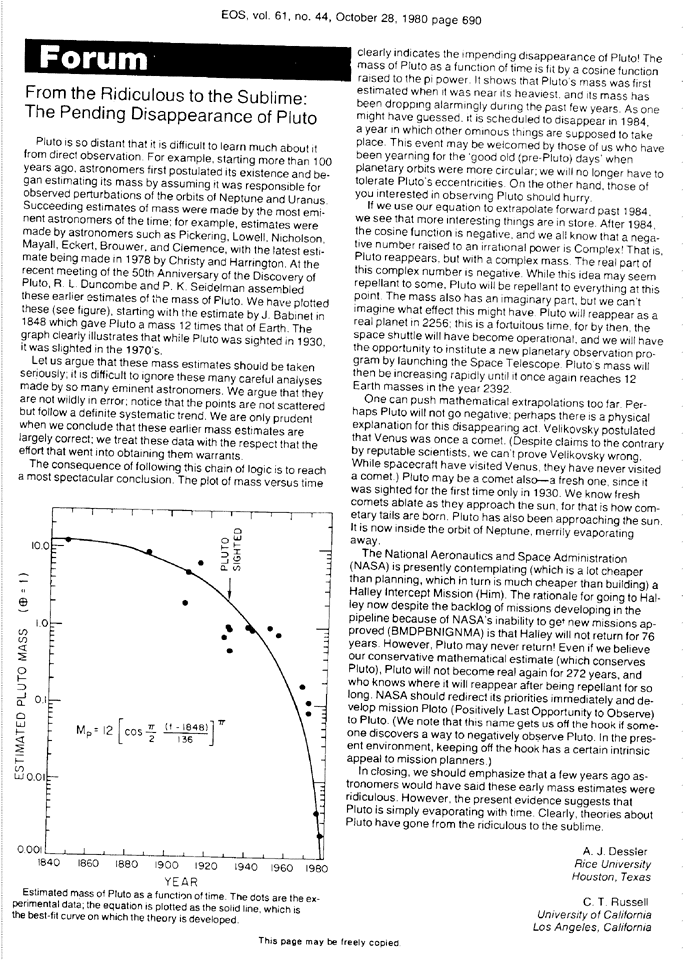
The impending disappearance of Pluto
A committee of the International Astronomical Union has proposed a new definition of "planet" which will be voted on next week in Prague. A planet would be defined as a body in orbit around a star and big enough for gravity to make it round.
This reminded me of something my father wrote in 1980 (click to see a larger version):

This reminded me of something my father wrote in 1980 (click to see a larger version):
Thursday, August 17, 2006
The IPCC
In a recent article that's getting lots of play in the blogosphere, John Fleck wrote:
However, we have to be careful about including views that are "too diverse." The goal of a scientific assessment is to let policymakers know what the scientific community thinks on an issue. If 99.9% of the scientists think one thing (e.g., the Earth is warming), then should the assessment include a dissenting view held by 0.1% of the community? I would argue not. Policymakers are often unable to discern a 99.9% position from a 0.1% position, and they look to expert assessments to do just that. If they don't, then the assessment has essentially abdicated its responsibility to clarify the science for the policymakers.
Obviously, this is one of the hard choices that the authors of assessments have. They have to use their judgment about what positions are credible within the majority community and what positions are simply outliers. Writing assessments is a tricky business, but they play such a crucial role that scientific community has to continue to work hard to make them the best possible source of information for policymakers.
So how should the public and policymakers, whipsawed by debate, sort out the competing claims? "That's easy," said Dessler, co-author of Cambridge University Press's "The Science and Politics of Global Climate Change." Dessler calls for the use of "expert assessments"- panels of specialists brought together to sort out and summarize scientific information for politicians, policymakers and the public. It's a common technique on all sorts of science-policy questions.There's a really interesting point here. I agree with Pielke Sr. that assessments have to include the range of opinions held by the majority of the scientific community. If half of the community says one thing and the other half says something else, then a good assessment will include both views. My sense is that the recent AGU assessment on hurricanes failed in this regard (see also this Prometheus post).
On climate change, a number of such reviews have been done, including work by the Intergovernmental Panel on Climate Change and the National Academy of Sciences. The panels' findings have been consistent and are reflected in the key finding in the IPCC's 2001 "Climate Change: The Science": Greenhouse gas emissions are altering Earth's climate.
Pielke Sr. has a different answer- listen to more diverse scientific voices. He thinks expert panels like the IPCC are inbred, representing a narrow focus on greenhouse gases. "The public is getting a very narrow view of the breadth of issues in climate science," he said.
However, we have to be careful about including views that are "too diverse." The goal of a scientific assessment is to let policymakers know what the scientific community thinks on an issue. If 99.9% of the scientists think one thing (e.g., the Earth is warming), then should the assessment include a dissenting view held by 0.1% of the community? I would argue not. Policymakers are often unable to discern a 99.9% position from a 0.1% position, and they look to expert assessments to do just that. If they don't, then the assessment has essentially abdicated its responsibility to clarify the science for the policymakers.
Obviously, this is one of the hard choices that the authors of assessments have. They have to use their judgment about what positions are credible within the majority community and what positions are simply outliers. Writing assessments is a tricky business, but they play such a crucial role that scientific community has to continue to work hard to make them the best possible source of information for policymakers.
Tuesday, August 15, 2006
Pat Robertson on global warming
There's been some interesting discussion on this blog about Pat Robertson's sudden and unexpected conversion to AGW believer.
I wrote that from a policy standpoint, Pat Robertson's conversion is huge. Policies that garner broad support have the best chance of getting adopted, and Pat Roberston brings real diversity into the AGW tent that wasn't there before. In particular, he brings a strong conservative presence that has been missing from the pro-action constituency for at least a decade.
A reader responded:
I wrote that from a policy standpoint, Pat Robertson's conversion is huge. Policies that garner broad support have the best chance of getting adopted, and Pat Roberston brings real diversity into the AGW tent that wasn't there before. In particular, he brings a strong conservative presence that has been missing from the pro-action constituency for at least a decade.
A reader responded:
I don't disagree ... about Pat bringing along a political clout, but really, would you or your distinguished scientists like to stand on the same podium and shake hands or be involved with someone that ridiculous and obviously unhinged? If you welcome him you endorse him, and that is not something a real scientist would do, only a political one.I reject this argument. While I am gratified that Pat R. acknowledges the strong scientific, economic, and moral case that exists for action on AGW, which I have been arguing for a few years, his endorsement of my position does not mean that I endorse anything else he says. [Ronald Reagan made basically this exact argument when someone odious endorsed him for President --- if anyone has the exact quote, please put it in the comments section.]
Sunday, August 13, 2006
Found in my in-box
A faithful reader of the 'blog has forwarded me this e-mail:
I've read these documents and they're full of the usual crap that gets rolled out for these: Humans are not causing warming; if they are, the warming will be small; and in any event, we can't do anything about this. Their arguments are, by and large, either normative value judgments, or are misleading or downright wrong scientific statements. [Note added in proof: also see the discussion here.]
From a strategic view, however, this type of campaign makes perfect sense. First, the recent emergence of an evangelical coalition in favor of action on climate change was one of the most significant events of the recent past. This represented a titanic shift in the political fault lines of this policy debate. Those opposed to action on climate change had to be terrified that they were on the brink of losing the entire policy debate. So this response makes perfect sense. Second, by arguing about science, they can drag the debate into a complete gridlock, as argued by Jon Miller. The report, with it's appearance of credibility and objectivity, leads the other side (those in favor of action) to leap to an enthusiastic defense of the reality of climate change - and the trap is sprung: the public tunes out (too boring), the media downgrade the story (too complex) and the politicians have the greatest excuse for doing nothing (let's wait until the science is clear).
Dear Dr. NameWithheldByRequest,Here are copies of the "Open letter," the ironically named "Call to truth," and the press release.
Fred Singer suggested that I send you the attached documents for your interest. If you would like to join Fred and many others in endorsing "A Call to Truth, Prudence, and Protection of the Poor: An Evangelical Response to Global Warming," we would be honored. You can do that simply by reply e-mail listing your name, title, and (for identification only) institutional affiliation, plus snail-mail address, phone number (for verification only), and a list of your degrees (subject, level, and granting institution). You will note that the "Open Letter" and "Call to Truth" are primarily from evangelicals and to evangelicals but that we have included endorsements by non-evangelicals with special relevant expertise. If you do endorse, please inform me whether I should list you among evangelicals or non-evangelicals. Thank you for your consideration.
In Christ,
Cal
E. Calvin Beisner, Ph.D.
Associate Professor of Historical Theology and Social Ethics
Knox Theological Seminary, 5554 N. Federal Hwy., Ft. Lauderdale, FL 33308
I've read these documents and they're full of the usual crap that gets rolled out for these: Humans are not causing warming; if they are, the warming will be small; and in any event, we can't do anything about this. Their arguments are, by and large, either normative value judgments, or are misleading or downright wrong scientific statements. [Note added in proof: also see the discussion here.]
From a strategic view, however, this type of campaign makes perfect sense. First, the recent emergence of an evangelical coalition in favor of action on climate change was one of the most significant events of the recent past. This represented a titanic shift in the political fault lines of this policy debate. Those opposed to action on climate change had to be terrified that they were on the brink of losing the entire policy debate. So this response makes perfect sense. Second, by arguing about science, they can drag the debate into a complete gridlock, as argued by Jon Miller. The report, with it's appearance of credibility and objectivity, leads the other side (those in favor of action) to leap to an enthusiastic defense of the reality of climate change - and the trap is sprung: the public tunes out (too boring), the media downgrade the story (too complex) and the politicians have the greatest excuse for doing nothing (let's wait until the science is clear).
Wednesday, August 09, 2006
Regional predictions
Take a look at this interesting editorial in the Rocky Mountain News. In it, they talk about whether regional forecasts of climate change are accurate or not:
The majority of scientists working with the United Nations' Intergovernmental Panel on Climate Change think not. The San Francisco Chronicle reported last month that most of them find local climate projections unreliable.I agree with much of what's in the article, but one thing I disagree with is:
Pielke dismissed the paper on his Climate Science blog (climatesci.atmos.colostate.edu/), stating that Diffenbaugh's method of prediction is not accurate enough to "add appropriate insight to be used by policymakers."One point I make in my book and here on this blog is that decisions to act are ultimately value judgments. While Pielke Sr. and Christy might not be moved to act based on a new scientific research, that does not mean that everyone shares their values. If I owned a bed and breakfast in VT and much of my business was based on tourists coming in to see the leaves turn every Fall, I'd be very concerned about changes in the New England climate, and might be spurred to act by this new research, even if others were not swayed.
Christy, who's also Alabama's state climatologist, also distrusts localized forecasts. He told the Chronicle, "I would not base economic decisions on the output of regional predictions from these models."
Aged skeptics
I've noticed a pattern recently. Some of the most vociferous skeptics of AGW are professors emeritus. No doubt, some people will argue that these are the most trustworthy sources, since their career is over and they are not dependent on getting funding.
However, I will advance a second theory. I was at a meeting a few weeks ago where I ran into Bill Gray, a famous emeritus skeptic. He gave his standard stump speech in which he claims that the water vapor feedback is negative. I followed up on this with him and it became quite clear to me that he is unfamiliar with all of the peer-reviewed literature on this subject that has been published in the last five years. This makes sense. Reading the literature is a difficult and full-time job, and emeritus faculty simply don't need to do that. Especially (in the case of Gray) when your time is occupied being interviewed and screaming at people. As a result, my sense is that the views of emeritus skeptics are often substantially out of date.
But the story goes on. After arguing with him for a few minutes, it became clear that Bill Gray has no scientific theory of his own *why* the water vapor feedback is negative, and no data to support his non-theory. He has no manuscript describing his non-theory and no plans to attempt to publish it. After I pointed out all of the evidence supporting a positive feedback, he looked confused and finally said, "OK, maybe the feedback isn't negative, maybe it's neutral. I'll give you that." I quickly concluded that he has no idea what he's talking about. I wish everyone that considers him credible could have witnessed this exchange.
Thus, we have two explanations for the emeritus-skeptic phenomenon: 1) only they are credible because their career is over, vs. 2) their knowledge is substantially out-of-date. My personal experience is that the second explains the phenomenon far better than the first.
And anyone with additional theories, please leave a comment.
My point is not that all emeritus are out of touch with the scientific literature. Some continue to be extremely credible (anyone swinging at that strawman will have their comment unceremoniously dumped into the electronic ether). My point is that we have to consider whether any particular emeritus scientific (either pro or con AGW) is familiar with the most current science. If their knowledge is 10-years old, then their statements might be quite incorrect.
However, I will advance a second theory. I was at a meeting a few weeks ago where I ran into Bill Gray, a famous emeritus skeptic. He gave his standard stump speech in which he claims that the water vapor feedback is negative. I followed up on this with him and it became quite clear to me that he is unfamiliar with all of the peer-reviewed literature on this subject that has been published in the last five years. This makes sense. Reading the literature is a difficult and full-time job, and emeritus faculty simply don't need to do that. Especially (in the case of Gray) when your time is occupied being interviewed and screaming at people. As a result, my sense is that the views of emeritus skeptics are often substantially out of date.
But the story goes on. After arguing with him for a few minutes, it became clear that Bill Gray has no scientific theory of his own *why* the water vapor feedback is negative, and no data to support his non-theory. He has no manuscript describing his non-theory and no plans to attempt to publish it. After I pointed out all of the evidence supporting a positive feedback, he looked confused and finally said, "OK, maybe the feedback isn't negative, maybe it's neutral. I'll give you that." I quickly concluded that he has no idea what he's talking about. I wish everyone that considers him credible could have witnessed this exchange.
Thus, we have two explanations for the emeritus-skeptic phenomenon: 1) only they are credible because their career is over, vs. 2) their knowledge is substantially out-of-date. My personal experience is that the second explains the phenomenon far better than the first.
And anyone with additional theories, please leave a comment.
My point is not that all emeritus are out of touch with the scientific literature. Some continue to be extremely credible (anyone swinging at that strawman will have their comment unceremoniously dumped into the electronic ether). My point is that we have to consider whether any particular emeritus scientific (either pro or con AGW) is familiar with the most current science. If their knowledge is 10-years old, then their statements might be quite incorrect.
Monday, August 07, 2006
The one-percent doctrine
Take a look at this interesting article on action and uncertainty. Here is an interesting quote:
A companion to the Cheney 1 percent action doctrine (if the probability is at least 1 percent, act) is the administration's non-action doctrine (if the probability is less than 99 percent, then don't act). This latter doctrine is generally invoked in discussions of global warming, where it seems absolute certainty is required to justify any significant action. Ideology determines which of these two inconsistent doctrines to invoke.As I've said here before, the threshold for action is a matter of values. We could pick any threshold we want for any problem. For climate change, my judgment is that, while we don't have certainty, we have enough evidence that a serious risk exists that we should take prudent action now.
Well said!
Take a look at this editorial in a recent Washington Post. The last paragraph makes a point that I've been trying to make for a while.
Sunday, August 06, 2006
Is today's warming man-made?
As George Bush said at a recent press conference: “the globe is warming. The fundamental debate: Is it manmade or natural.”
Why does the scientific community think that humans are significantly contributing to today’s warming? To understand why, first recognize that whenever the climate shifts, there’s a reason for it. It does not wander around like a drunken sailor.
Based on decades of research, we can write down the factors that have influenced climate in the past:
If we look at the warming of the last few decades, we can immediately rule out tectonic activity and orbital variations because they are much much too slow to account for the warming over a few decades. We can rule out volcanic eruptions for a similar reason --- they affect the climate for only a few years. Thus, volcanic eruptions are also likely unrelated to the several-decades long temperature increase we are experiencing.
We can rule out solar variability because we have high-accuracy measurements of the output of the Sun from satellites since the mid-1970s, and we have not seen the increase in solar output necessary to explain the temperature increase. This is not to say that solar is playing no role, just that it cannot explain the majority of the observed warming.
Internal variability is the hardest to evaluate. We know that ENSO significantly changes the Earth’s temperature, and so long-term ENSO-like variation is something that we have to consider. However, nobody has yet put forth a viable mechanism or shown data that such a long-term cycle exists. In the absence of any evidence supporting it, we conclude that it’s likely that internal variability is playing a minor role in today’s warming. Clearly, future research might cause us to re-examine this conclusion.
Finally, we have greenhouse gases. In this case, things work out well. Both the timing and magnitude of today’s warming are well explained by greenhouse gases.
This is why scientists conclude that humans are likely responsible for most of the warming of the last few decades. Greenhouse gases provide a reasonable explanation for the warming, while no other factor can explain the entire warming (other factors, such as solar, might be playing a minor role, however). In the IPCC report, they attach the word “likely” to the statement about the importance of greenhouse gases, which denotes about 75% confidence that the statement is true. This takes into account our imperfect knowledge of the atmosphere, in particular with regards to internal variability, and that future work might lead to revisions of our views of this.
Finally, note that this conclusion does not come solely from GCMs. Instead, it sits on a much firmer foundation of a range of peer-reviewed studies that use a wide range of techniques. One of the things that gives us confidence is that the studies all paint a consistent picture of today's warming.
Why does the scientific community think that humans are significantly contributing to today’s warming? To understand why, first recognize that whenever the climate shifts, there’s a reason for it. It does not wander around like a drunken sailor.
Based on decades of research, we can write down the factors that have influenced climate in the past:
- Tectonic activity: The arrangement of continents plays an important role in determining the climate, and if the continents move, the climate might very well change.
- Orbital variations: The ice age cycles of the past few million years are driven by changes in the orbit of the Earth about the Sun. The Earth’s orbit has important variations with time periods of approximately 25,000, 40,000, and 100,000 years.
- Solar variations: The sun is the primary energy source for our climate. As the output of the sun changes, so does the climate.
- Volcanoes: They inject ash and aerosols into the atmosphere, which reflect incoming sunlight. A strong eruption can cool the Earth for several years.
- Internal variability: The climate system is complicated, and internal modes of variability exist. The most well known one is the El Nino/Southern Oscillation (ENSO). During the El Nino phase, the Earth is much warmer than during the opposite phase, the La Nina.
If we look at the warming of the last few decades, we can immediately rule out tectonic activity and orbital variations because they are much much too slow to account for the warming over a few decades. We can rule out volcanic eruptions for a similar reason --- they affect the climate for only a few years. Thus, volcanic eruptions are also likely unrelated to the several-decades long temperature increase we are experiencing.
We can rule out solar variability because we have high-accuracy measurements of the output of the Sun from satellites since the mid-1970s, and we have not seen the increase in solar output necessary to explain the temperature increase. This is not to say that solar is playing no role, just that it cannot explain the majority of the observed warming.
Internal variability is the hardest to evaluate. We know that ENSO significantly changes the Earth’s temperature, and so long-term ENSO-like variation is something that we have to consider. However, nobody has yet put forth a viable mechanism or shown data that such a long-term cycle exists. In the absence of any evidence supporting it, we conclude that it’s likely that internal variability is playing a minor role in today’s warming. Clearly, future research might cause us to re-examine this conclusion.
Finally, we have greenhouse gases. In this case, things work out well. Both the timing and magnitude of today’s warming are well explained by greenhouse gases.
This is why scientists conclude that humans are likely responsible for most of the warming of the last few decades. Greenhouse gases provide a reasonable explanation for the warming, while no other factor can explain the entire warming (other factors, such as solar, might be playing a minor role, however). In the IPCC report, they attach the word “likely” to the statement about the importance of greenhouse gases, which denotes about 75% confidence that the statement is true. This takes into account our imperfect knowledge of the atmosphere, in particular with regards to internal variability, and that future work might lead to revisions of our views of this.
Finally, note that this conclusion does not come solely from GCMs. Instead, it sits on a much firmer foundation of a range of peer-reviewed studies that use a wide range of techniques. One of the things that gives us confidence is that the studies all paint a consistent picture of today's warming.
Friday, August 04, 2006
Climate change on Lehrer Newshour
I've heard that the Newshour with Jim Lehrer (forever known to me as the McNeil/Lehrer Newshour) is likely(*) going to have a discussion tonight about climate change. This is probably motivated by the present heatwave. I've also heard that they're trying to get someone from the NAS Hockey Stick Panel to appear. I'll be tuning in.
[Addendum: They did not end up having any scientist on. Also, you can find a transcript and realaudio of the segment here.]
(*) Likely denotes confidence level of 75%
[Addendum: They did not end up having any scientist on. Also, you can find a transcript and realaudio of the segment here.]
(*) Likely denotes confidence level of 75%
Wednesday, August 02, 2006
Is the science of climate change settled?
In the early 1990s, I worked on stratospheric photochemistry, i.e., ozone depletion. I even wrote a book about it (makes a great gift for that person who has everything!). By the mid-1990s, it was clear to me that the science of stratospheric ozone was truly settled. We understood just about everything. You know what I did? I decided to switch fields and study the climate system.
A constant argument in the policy debate over climate change is whether "the science of climate change is settled." It is clearly not. If it were, then I would have switched to another field, just as I did in the mid-1990s. No respectable scientist wants to do research on a system that's well understood.
However, everyone needs to recognize that we don't need perfect knowledge in order to take action. We make important decisions in the face of uncertainty all the time (e.g., should we invade Iraq?). In the case of climate change, we know enough to know that climate change carries a very real risk of severe, even catastrophic impacts over the next century. We can argue about the exact value of the risk: is it 20%, 50%, or 80%? I don't know the exact value, but it's not zero.
The decision about what to do about the uncertain risk of climate change is a policy decision and not a scientific result. How risk averse are we? Are we willing to trade some economic growth to reduce a risk of catastrophic climate change? This is something we have to decide as a society, and this is where the public debate needs to be.
A constant argument in the policy debate over climate change is whether "the science of climate change is settled." It is clearly not. If it were, then I would have switched to another field, just as I did in the mid-1990s. No respectable scientist wants to do research on a system that's well understood.
However, everyone needs to recognize that we don't need perfect knowledge in order to take action. We make important decisions in the face of uncertainty all the time (e.g., should we invade Iraq?). In the case of climate change, we know enough to know that climate change carries a very real risk of severe, even catastrophic impacts over the next century. We can argue about the exact value of the risk: is it 20%, 50%, or 80%? I don't know the exact value, but it's not zero.
The decision about what to do about the uncertain risk of climate change is a policy decision and not a scientific result. How risk averse are we? Are we willing to trade some economic growth to reduce a risk of catastrophic climate change? This is something we have to decide as a society, and this is where the public debate needs to be.
Healthy Talk Radio
I'll be on Healthy Talk Radio tomorrow (Thursday) morning at 8:15 AM EDT talking about my theories on how we can all live longer by taking bee pollen and adopting a macrobiotic diet. Just joking, I'll be talking about climate change.
Tuesday, August 01, 2006
Science and Nature
When I was in grad school, we used to have a saying:
Just 'cause a paper's in Science [Nature] doesn't automatically mean it's wrongIn all seriousness, while those two journals have published a lot of groundbreaking work, a disproportionately large fraction of what gets published there turns out to be crap. The reason is that these two journals evaluate papers differently than other journals. Science and Nature put a high premium on newsworthiness, while most other journals do not. As a result, people trying to get their papers into Science or Nature often "sex up" the paper's conclusions a little further than perhaps the data warrants. And the most speculative papers are often the most newsworthy --- but also the most often wrong. A final problem is that the strict length limit means that many details of the analysis must be left out (this is less true now that details can be put into electronic supplements). This dearth of details hinders the identification of problems by peer reviewers. Thus, I would tend to agree with the views of the Capitol Hill staffer described in this Prometheus post:
An interesting detail was that one staffer spoke about a "discounting" of scientific results conditional upon in which journal the result was published. Science is associated with a low level of credibility whereas GRL is considered a generally "good" source.
Subscribe to:
Posts (Atom)